We've launched our BETA! Shape the most trusted auto parts marketplace. New vendors daily—check back often!

How to Know a Car Part Will Fit Before You Buy It
The worst moment in a DIY repair isn't the stuck bolt or the rounded nut. It's holding the new part next to the old one and realising the mounting holes don't line up — with the car already apart in the driveway.
It happens constantly, and almost never because someone was careless. It happens because "a 2015 Camry" isn't one car. It's a family of builds that share a name and differ in the details that matter.
Here are the three ways to check fitment, what each one actually proves, and when to use which.
tag!
Why year, make and model isn't enough
Carmakers don't build one version of a model and leave it alone for a generation. Across a single model year you can find more than one engine, several trim levels, mid-year production changes, and — for a car sold in both North America and elsewhere — different components meeting different regulations.
That's why two cars that look identical in a parking lot can take different alternators. Any of these can change which part you need:
- Engine. The most common culprit. A four-cylinder and a V6 of the same model year rarely share filters, belts, mounts or cooling parts.
- Trim level. Higher trims often come with larger brakes, different suspension tuning, or climate control the base model doesn't have.
- Production date. Manufacturers revise parts mid-year. A car built in October can differ from one built the previous March.
- Where it was built. Some models are assembled in more than one plant, with locally sourced components.
- Options. Towing packages, cold-weather packages and performance options all change hardware.
Year, make and model gets you close. It just doesn't get you certain.
Method 1: Your VIN
Your Vehicle Identification Number is the 17-character code that identifies your specific car. Not the model — the car sitting in your driveway.
It's stamped into the vehicle at the factory and encodes how that car was actually built: engine, body style, plant, model year and a unique serial number. Nothing else you can look up is that specific.
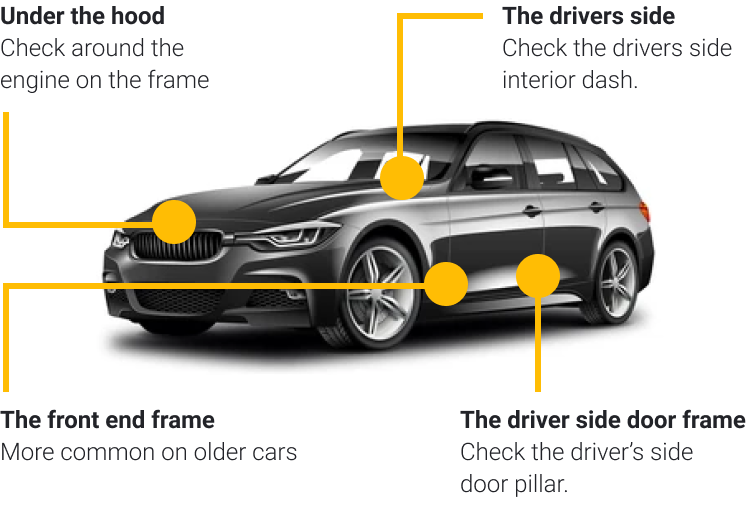
Where to find it:
- Through the windshield, lower corner on the driver's side
- On the sticker in the driver's door jamb
- On your registration, insurance card or title
A VIN is always 17 characters and never contains I, O or Q — those letters are left out so they can't be mistaken for 1 and 0.
What it proves: that a part was listed by the manufacturer as fitting your exact build. This is the strongest check available to a home mechanic.
Where it falls short: it describes the car as it left the factory. If a previous owner swapped the engine or fitted aftermarket brakes, your VIN won't know.
Method 2: The number on the part you're replacing
If the old part is already off the car — or you can see it — find the number stamped, etched or printed on it. On most parts it's moulded into the casing or on a label.
This is the most literal check there is: you're matching a part to the part that was already working.
What it proves: that the replacement is the same component, or a listed equivalent.
Where it falls short: two traps. First, the number on the part may be the manufacturer's number rather than the carmaker's, and the two look nothing alike. Second, if a previous owner already fitted the wrong part, you'll faithfully order another wrong one.
If the number is unreadable — common on anything near the exhaust — fall back to the VIN.
Method 3: Interchange and cross-reference
One physical part can carry half a dozen numbers: the carmaker's original number, the numbers used by each aftermarket brand that makes an equivalent, and sometimes a superseded number from when the design was revised.
Interchange is the mapping between them. It's how you discover that the filter you're holding is sold by four brands under four numbers, all fitting the same engine.
What it proves: that an alternative part is a listed equivalent — useful when the original is discontinued, expensive, or out of stock.
Where it falls short: interchange says parts are equivalent, not identical. Equivalents can differ in material, expected life and warranty. For a cabin filter that hardly matters. For brake components it matters a great deal.
Which method to use
- Starting from scratch, part still on the car: use your VIN
- Old part already off and readable: use its number, then confirm against your VIN
- The exact part is unavailable or costs more than you want to spend: use interchange to find a listed equivalent
- The car has modifications: the number on the fitted part beats the VIN, because the VIN describes the car before those changes
When two methods agree, you can order with confidence. When they disagree, something has been changed on the car — and that's worth understanding before you buy anything.
Five habits that prevent most mistakes
- Photograph the old part before removing it, including any numbers. Take more pictures than you think you need
- Check both sides. Many parts are side-specific, and "left" usually means the driver's side as you sit in the car — but not always. Look for an L or R in the number
- Count the connector pins. Sensors and switches that look identical often differ by one pin
- Note your build date, on the door jamb sticker, for anything on a model that changed mid-year
- Read the returns policy before ordering, not after. Electrical parts in particular are often non-returnable once fitted
The short version
Your VIN tells you how the car was built. The number on the old part tells you what's actually fitted. Interchange tells you what else will do the job. Most fitment problems come from skipping all three and trusting the model name.
Two minutes of checking is cheaper than a return, and far cheaper than a car stuck on axle stands waiting for the right part.
Ready to find yours? Enter your VIN, your license plate or your year, make and model at thepartmarket.com — every result is matched to your vehicle using fitment data straight from the manufacturers.